Every buyer asks the same question. Every single one.
"What's the neighborhood like?"
They want to know if there are good schools. If they can walk to a coffee shop. Whether there's a grocery store nearby or if everything requires a 20-minute drive. What the homes are worth. What kind of people live there.
The agent who answers that question well -- with real data, not vague opinions -- wins the client. The loan officer who sends that answer proactively wins the referral. The agent who shrugs and says "it's a nice area" loses to someone who came prepared.
This article is about how to be the one who comes prepared. Every time, for every ZIP code, without spending hours on it.
The Neighborhood Knowledge Gap
There are roughly 2 million licensed real estate agents in the United States. Most of them know their immediate farm area well enough to answer basic questions. But the moment a client asks about a neighborhood that's 15 minutes outside their usual territory, things get shaky.
Here's what typically happens:
- The agent Googles the ZIP code and scans a few websites
- They check Zillow for home values and maybe GreatSchools for ratings
- They piece together a mental picture and deliver it conversationally
- The buyer goes home and Googles the exact same things
Nothing about this process positions the agent as an expert. The buyer gets the same information on their own. Worse, the agent has nothing tangible to leave behind -- no document, no handout, nothing shareable.
The agents who stand out aren't the ones who know more. They're the ones who present what they know in a way that feels authoritative, professional, and worth sharing.
What a Neighborhood Expert Actually Does Differently
Top-producing agents who consistently win listings in competitive markets do something that most agents never think to do: they lead with data.
Not a pitch. Not a market update email. Not a generic flyer. They hand the buyer (or seller, or borrower) a single-page infographic that answers every neighborhood question in one glance:
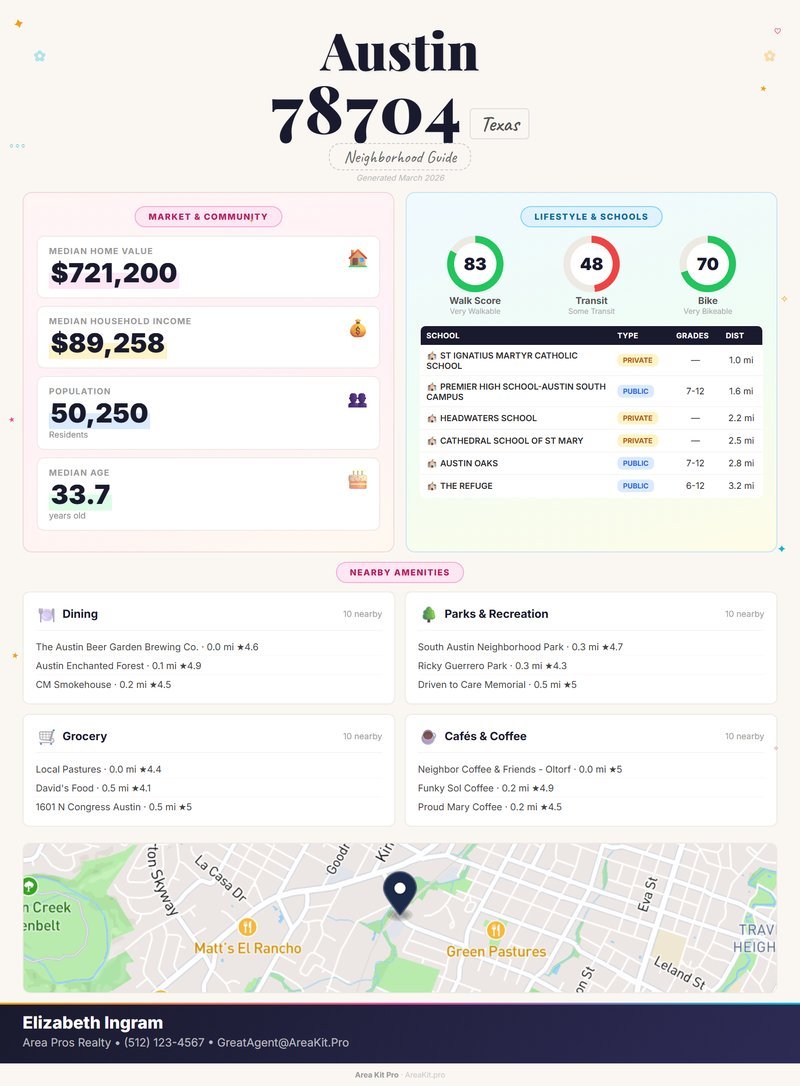
- Demographics: Population, median age, household income, home values
- Walkability: Walk Score, Bike Score, Transit Score
- Schools: Nearby public and private schools with grade levels
- Amenities: Top-rated restaurants, cafes, parks, grocery stores
- A map: So the buyer can orient themselves geographically
- Agent branding: The agent's name, phone, email, and brokerage
When a buyer shows this to their spouse at dinner, the agent's name is right there at the bottom. When they share it in a group chat with friends, the agent's contact info goes with it. When they pin it to their fridge while house hunting, it's the agent's face they see every morning.
That's the difference between being an agent and being their agent.
The Problem: This Used to Be Expensive and Slow
Creating a neighborhood profile like this used to require one of three approaches, all of them painful:
Option 1: Do It Yourself in Canva
Open a blank template. Google the Census data. Look up Walk Score. Search for schools. Find restaurant recommendations. Copy and paste everything. Arrange it. Make it look decent. Export. Repeat for every new area a client asks about.
Time: 1-2 hours per guide. Per neighborhood.
Option 2: Hire a Designer
Send the data to a graphic designer. Wait 2-5 days. Pay $50-200. Get something beautiful, but only for that one ZIP code. Need another area? Start over.
Cost: $50-200 per guide. Not scalable.
Option 3: Skip It
Most agents take this option. They answer the neighborhood question verbally, maybe send a few links, and hope the buyer doesn't notice that the agent across town has a better-looking packet.
Cost: Lost clients you'll never know about.
The Solution: 60 Seconds, Any US ZIP Code
We built Area Kit Pro because we were frustrated by all three options. The data is public. The design can be templated. The process can be automated. So we automated it.
Here's how it works:
Enter a ZIP Code
Any of the 41,000+ US ZIP codes. Urban, suburban, or rural -- they all work. For rural areas, we automatically expand our data search to find nearby amenities and use county-level demographics when neighborhood-level data isn't available.
Pick a Style
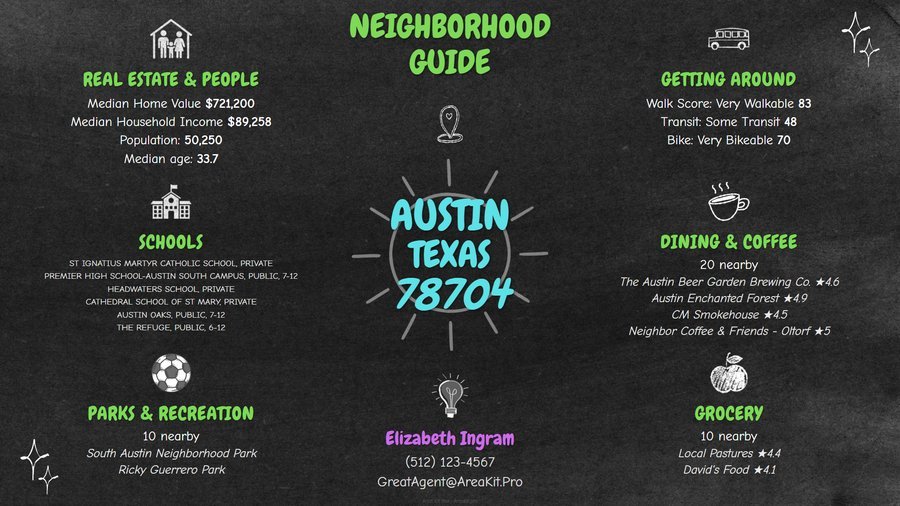
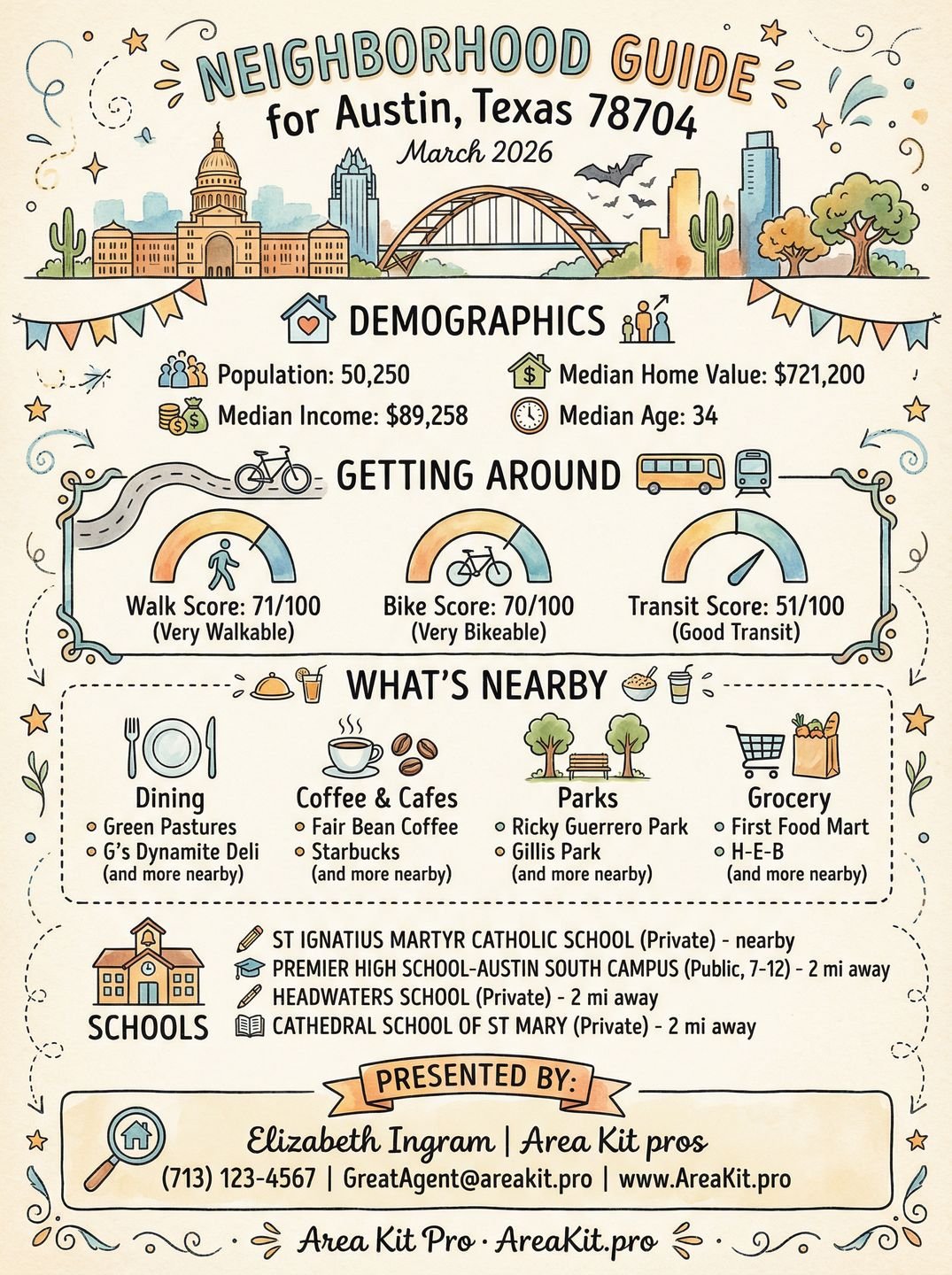
Professional is a clean portrait layout (8.5x11") that prints beautifully for listing packets and client handouts. Chalkboard is a landscape design with hand-drawn doodles that pops on Instagram and Facebook. Sketch Style is AI-generated art -- unique every single time, a conversation starter that no other agent has.
Add Your Branding
Your name, phone number, email, brokerage, and website. It's built directly into the design -- not stamped on as an afterthought. Your information is saved so it auto-fills for future guides.
Download and Share
You get both a PNG (for social media and email) and a PDF (for printing). Share it with a client, post it to your feed, hand it out at an open house, or attach it to a listing presentation.
The whole process takes under 60 seconds. The data is pulled in real time from seven trusted sources including the US Census Bureau, Walk Score, Google Places, and the National Center for Education Statistics.
7 Ways to Use a Neighborhood Guide
A neighborhood guide isn't a one-trick tool. Here are the highest-impact ways agents, loan officers, and other professionals are using them:
1. Social Media Content (Instant Engagement)
Post the infographic to Instagram, Facebook, or LinkedIn with a caption like: "Here's what it's really like to live in [Neighborhood]. Median home value, walkability, top restaurants, schools -- all in one page." These posts consistently outperform generic listing photos because they provide genuine value to anyone in that market.
2. Buyer Consultation Handouts
When you sit down with a buyer for the first time, hand them a neighborhood guide for the areas they're considering. It instantly positions you as someone who did their homework. Compare it to the agent who showed up with just a stack of MLS printouts.
3. Open House Leave-Behinds
Print the guide and set it on the kitchen counter next to the sign-in sheet. Every visitor takes one home. Your name and phone number go with them. It's the most useful flyer at any open house because it answers the question every visitor is already wondering.
4. Listing Presentation Ammo
Include a neighborhood guide in your listing presentation to show sellers that you understand the market at a deeper level. It demonstrates that you'll market their home in context -- not just the property, but the lifestyle. Sellers want to know you can sell the neighborhood, not just the house.
5. Loan Officer Pre-Approval Follow-Ups
You're a loan officer who just pre-approved a borrower for $400K. They're looking in three different areas. Send them a neighborhood guide for each one with your name on it. They share it with their spouse. They remember you. When their coworker asks who they used for their mortgage, your name comes up -- not because of your rate, but because you went above and beyond.
6. Farm Area Marketing
Generate guides for every ZIP code in your farm area. Post one per week on social media. Over time, you become synonymous with that market. People start associating your name with neighborhood expertise in that area. That's how farming is supposed to work.
7. Relocation Clients
When a client is relocating from another state, they know nothing about your market. A neighborhood guide is the single most useful thing you can send them. It answers every question they'd spend hours Googling -- and it has your name on it.
Ready to Try It?
Generate your first neighborhood guide in 60 seconds. No subscription, no design skills, no commitment. Just enter a ZIP code.
Get Started at AreaKit.proThe Data Behind Every Guide
One concern we hear from agents: "How do I know the data is accurate?"
Every data point in an Area Kit Pro guide comes from an authoritative, trusted source. We don't estimate, guess, or scrape random websites. Here's exactly where each piece of information comes from:
- Population, income, age, home values -- US Census Bureau, American Community Survey 5-Year Estimates. This is the same dataset used by the Federal Reserve, HUD, and every serious market analysis.
- Walk Score, Bike Score, Transit Score -- Walk Score API, the industry standard used by Redfin, Zillow, and every major real estate portal.
- Nearby restaurants, cafes, parks, grocery stores -- Google Places API with real ratings from Google Maps users.
- Schools -- National Center for Education Statistics (NCES), a division of the US Department of Education.
- Map -- Mapbox, used by The Weather Channel, DoorDash, and thousands of other applications.
For rural ZIP codes and PO Box areas where neighborhood-level Census data isn't available, we automatically use county-level demographics. The data is slightly broader but still accurate and useful -- and far better than showing nothing.
Who Is This For?
Area Kit Pro was designed for anyone who needs to communicate what a neighborhood is like:
- Real estate agents -- solo agents, teams, and brokerages of any size
- Mortgage loan officers -- differentiate on service, not just rates
- Chambers of commerce -- community profiles for relocation packets and economic development
- Tourism and visitor bureaus -- destination marketing with real data
- Home sellers -- enhance your listing with neighborhood context
If you've ever been asked "what's the area like?" by a client, a buyer, or a relocating family member, this tool was built for you.
Simple Pricing, No Commitment
Area Kit Pro is pay-per-use. No subscription. No monthly fee. Buy credits and use them whenever you need a guide.
- 1 guide: $4.99
- 5 guides: $19.99 ($4.00 each -- save 20%)
- 10 guides: $34.99 ($3.50 each -- save 30%)
- 25 guides: $74.99 ($3.00 each -- save 40%)
For the cost of a coffee, you get a professional, data-driven, branded infographic that you can use for months. For the cost of a nice lunch, you can cover an entire farm area.
The Bottom Line
The real estate agents who win in 2026 and beyond won't be the ones who know the most about neighborhoods. Information is everywhere. They'll be the ones who present that information in a way that's professional, shareable, and branded with their name.
That's what a neighborhood expert looks like. Not someone who memorized every school rating -- someone who hands you a beautiful guide with all of it in one place and says, "Here. I made this for you."
That agent gets remembered. That agent gets referred. That agent closes.
Be that agent.
Generate Your First Guide Now
Enter any US ZIP code. Pick a style. Add your branding. Download in 60 seconds.
Try Area Kit Pro Free